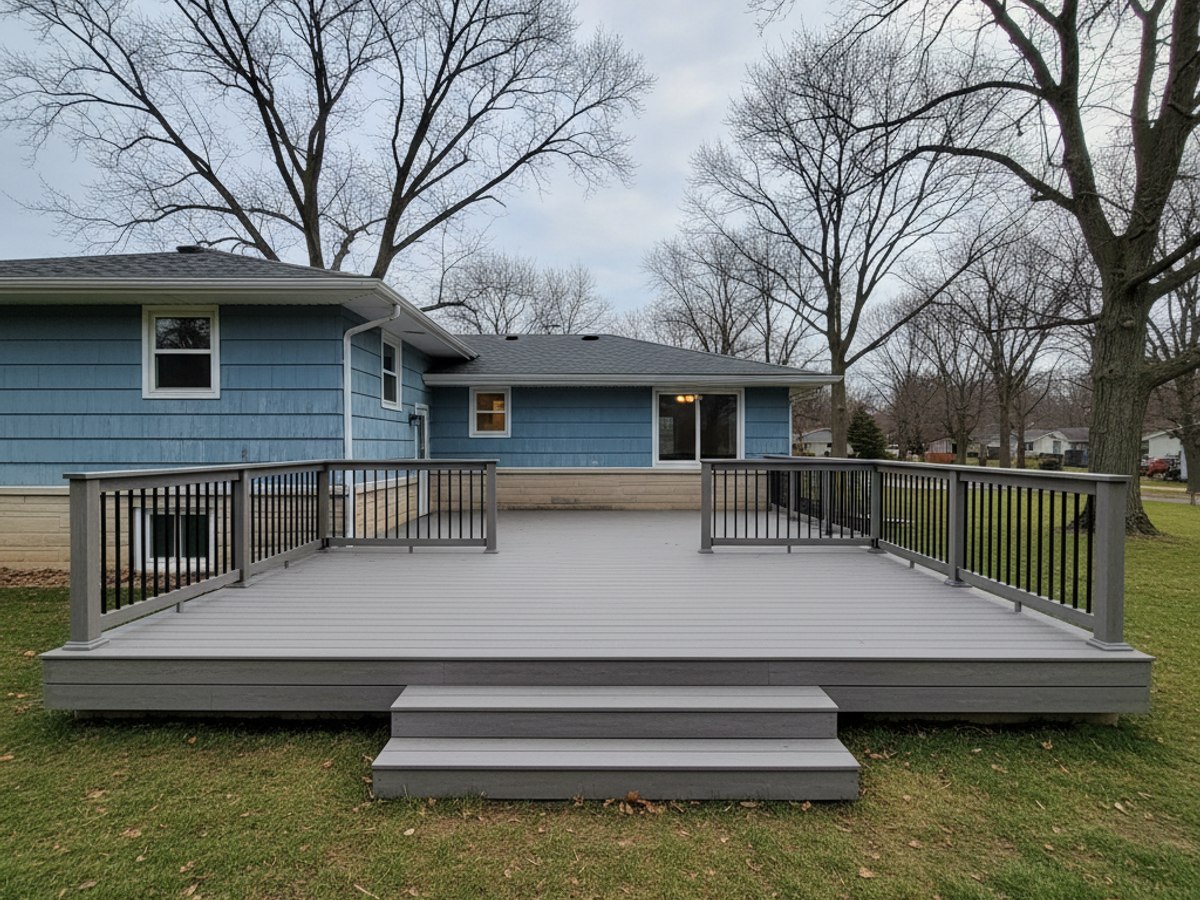
Most people shopping for a deck builder end up comparing three bids that all say roughly the same thing: quality materials, experienced crew, free estimate. That tells you nothing. The questions that actually separate a good deck from a bad one are boring, and they're the ones most homeowners never think to ask.
Permits aren't optional, and a builder who skips them is telling you something
West Allis requires a building permit for most new deck construction, and the inspector will want to look at footings before you backfill them and at the framing before the boards go down. If a builder tells you permits are a waste of time or that they can just "get it done quietly," that's not a shortcut, that's a builder who doesn't want an inspector checking their work. Permit season here tends to run heavy from April through June, once the ground has thawed enough to dig, so if you're calling in March expect a longer wait for both the permit and the crew's schedule.
Ask directly: who pulls the permit, you or them? It should be them, and it should be in the contract. Ask if they've worked with the city's inspectors before. A builder who's pulled permits in West Allis for years knows exactly what the inspection will look for and won't be surprised by it.
Footings: the part nobody sees, and the part that matters most
Southeastern Wisconsin gets somewhere around 35 to 40 freeze-thaw cycles in a normal winter, and the ground here is mostly heavy clay till. Clay holds water, and water that freezes expands. A footing that doesn't go deep enough will heave in January and settle in April, and over a few years that shows up as a deck that's slowly gone out of level, railing posts that lean, and a ledger board pulling away from the house.
Local frost depth requirements in this area generally call for footings around 42 inches down, sometimes deeper depending on soil and design. That's not a number a builder should have to look up on the spot. If you ask how deep the footings will go and you get a vague answer, that's worth noting. The concrete pier itself is usually 8 to 12 inches in diameter, sitting on undisturbed soil, not on fill dirt or backfill from digging the hole. On older lots in West Allis, especially the smaller lots near National Avenue and through the bungalow and cape cod streets built in the 1920s through the 1950s, you can also hit old clay tile drain lines or buried debris a few feet down. A builder who's dug in this town before won't be caught off guard by that.
The ledger board is where decks actually fail
When a deck collapses, it's almost never the boards. It's the ledger board, the piece bolted to the house that the whole structure hangs off of. It needs to be lag-bolted or through-bolted with proper structural screws, not just nailed, and it needs flashing behind it so water doesn't get trapped between the ledger and the siding and rot the house's framing from the inside. This is the single most common shortcut on a bad deck job, because it's fast to skip and nobody notices until the wood is soft five years later.
Ask what fasteners they use on the ledger and whether they flash it. If the answer is a shrug, keep shopping.
Materials: what you're actually paying for
Pressure-treated pine is still the most common frame material and it's fine for structure, but it needs to sit and dry before staining, usually a few months, or the sealer won't take. Composite decking costs more up front, doesn't need staining, and handles Wisconsin's freeze-thaw swings without cupping or splintering the way old lumber can. Joist spacing matters too. 16 inches on center is standard for most decking; some composite boards call for 12 inches on center to avoid a bouncy feel underfoot. A builder should be able to tell you the span table they're working from without opening a manual on your porch.
None of this is exotic knowledge. It's the stuff a builder who's actually built decks in this climate just knows, the same way a roofer knows what ice damming does to a soffit.
What to look for, and what to walk away from
- Ask for proof of liability insurance and worker's comp, not just a business card. If they hesitate, that's your answer.
- Get the footing depth, fastener type, and joist spacing in writing, not just "we'll figure it out on site."
- A written contract with a payment schedule tied to phases of work, not a large deposit up front before anything's been dug.
- References to actual addresses you can drive by, not just photos on a phone.
- Walk away from anyone who wants full payment in cash before starting, or who can't tell you who's pulling the permit.
- Walk away from a quote that's dramatically lower than the others without an explanation. Somewhere in that number, a footing is getting shallower or a ledger is getting nailed instead of bolted.
Newer subdivisions versus older streets
If you're out toward New Berlin, Franklin, or Muskego in a newer subdivision, there's a decent chance an HOA has rules about deck height, railing style, or how close you can build to a property line, and some of those developments also carry deed setbacks tighter than the city's own zoning. Older West Allis lots usually don't have an HOA to deal with, but they're often narrower, which means setback distance to the neighbor's fence line can be tight enough that it changes the whole design. A builder who asks about your lot line and your neighborhood before quoting a price is doing it right. One who quotes a flat number over the phone without ever seeing the lot is guessing.
A deck is one of the few home projects where the part you'll actually enjoy, the railing, the boards, the stain color, is maybe 20 percent of what makes it last. The other 80 percent is underground or bolted to your house where you'll never look at it again. That's exactly why it's worth asking the unglamorous questions before you sign anything. If you want a second opinion on a quote you've already gotten, or you're starting from scratch, our deck builder work in West Allis and the surrounding towns is a phone call away.